Maine Overall: Developing
- Cash and CBDC: Limited
- Facial recognition: Strong or meaningful
- Government AI: Partial
- Electronic data warrants: Meaningful state protection
- Data broker loophole: Open gap

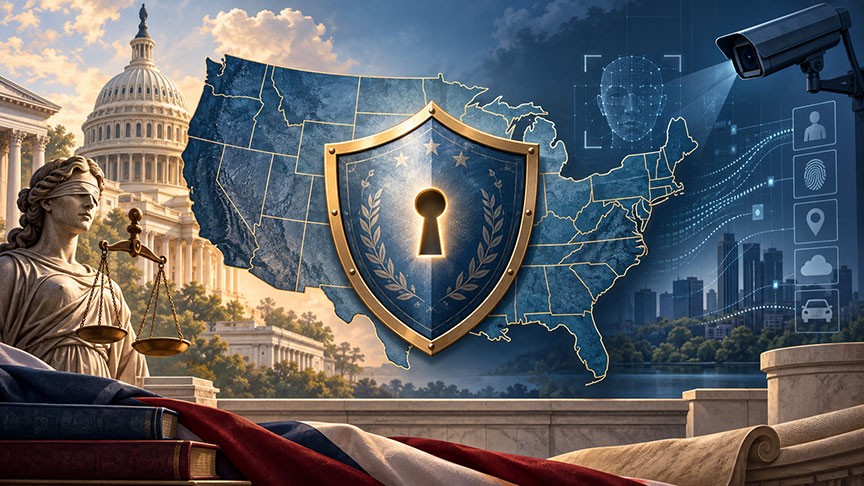
Your face can be scanned by a camera you never noticed. Your movements can be reconstructed from location records held by a private company. Your purchases can be analyzed, your communications requested, and an artificial-intelligence system can help a government agency decide that you deserve closer attention. Much of this can happen without the average person knowing which rules apply.
Montana Senator Ken Bogner recently summarized five protections his state has pursued in an Instagram video that inspired this national comparison: preserve cash, restrict continuous facial recognition, limit government use of artificial intelligence, require warrants for electronic information, and close the loophole that lets government buy personal data from commercial brokers.
This guide asks a simple question: how closely does each state match those five protections? The answer is an uneven national patchwork. Use the state index below to jump directly to your state.
1. Cash and CBDC protection
Does state law preserve a practical right to use physical cash or restrict state participation in a central-bank digital currency?
2. Facial-recognition limits
Are police or other agencies subject to warrants, narrow permitted uses, notice rules, corroboration requirements, or bans on continuous face surveillance?
3. Government AI limits
Must agencies disclose, assess, limit, or provide human oversight for government AI systems?
4. Electronic-data warrants
Does state law require judicial authorization for important communications, devices, location information, or stored data?
5. The data-broker loophole
Can government buy personal information from a commercial broker that it would otherwise need legal process to obtain?
The overall assessment summarizes how completely a state addresses all five areas together. It is a comparative editorial rating, not an official government grade or a legal conclusion. Only enacted statewide protections receive full weight.
Select a state, then open its compact card to see all five results.
These summaries are designed for quick comparison. “Federal baseline” means federal constitutional and statutory protections still apply, even when no comparably broad state statute was confirmed.
No state except Montana clearly satisfies all five tests as a coordinated package. Several states perform well in one or two categories, but the gaps rarely line up. A state may protect consumers from private-sector data sales while still allowing government agencies to buy commercially available information.
Cash protection also requires careful language. Requiring a store to accept paper currency is not the same as preventing a state agency from participating in a central-bank digital currency. The strongest policy protects access to cash while preventing compulsory participation in a traceable government payment system.
The data-broker loophole remains the largest national weakness. Consumer privacy laws often give people rights against businesses, but those rights do not automatically require government agencies to obtain a warrant before purchasing location or behavioral data.
Useful technology does not have to mean unchecked surveillance. Facial recognition can help locate a missing child, electronic records can identify a violent offender, and AI can help a public agency process routine work. The safeguard is due process: narrow authorized uses, independent judicial review, transparency, human accountability, meaningful penalties, and no purchasing around the warrant requirement.
Montana has given the country a useful five-part test. Every resident should be able to ask where their state stands, which gaps remain, and whether their representatives are prepared to close them.
Part Two examines laws that states have already enacted, presents five model provisions, and explains how citizens can approach their legislators with a focused request.
Read Part Two: Five Laws Every State Should Consider
This public-interest guide was reviewed in September 2026 and summarizes a fast-changing area of law. It is not legal advice. State statutes contain definitions, exemptions, delayed effective dates, agency-specific rules, and judicial interpretations that cannot be fully reproduced in a short national guide. Readers should consult the linked sources and current official code before relying on a provision in a legal matter.
